
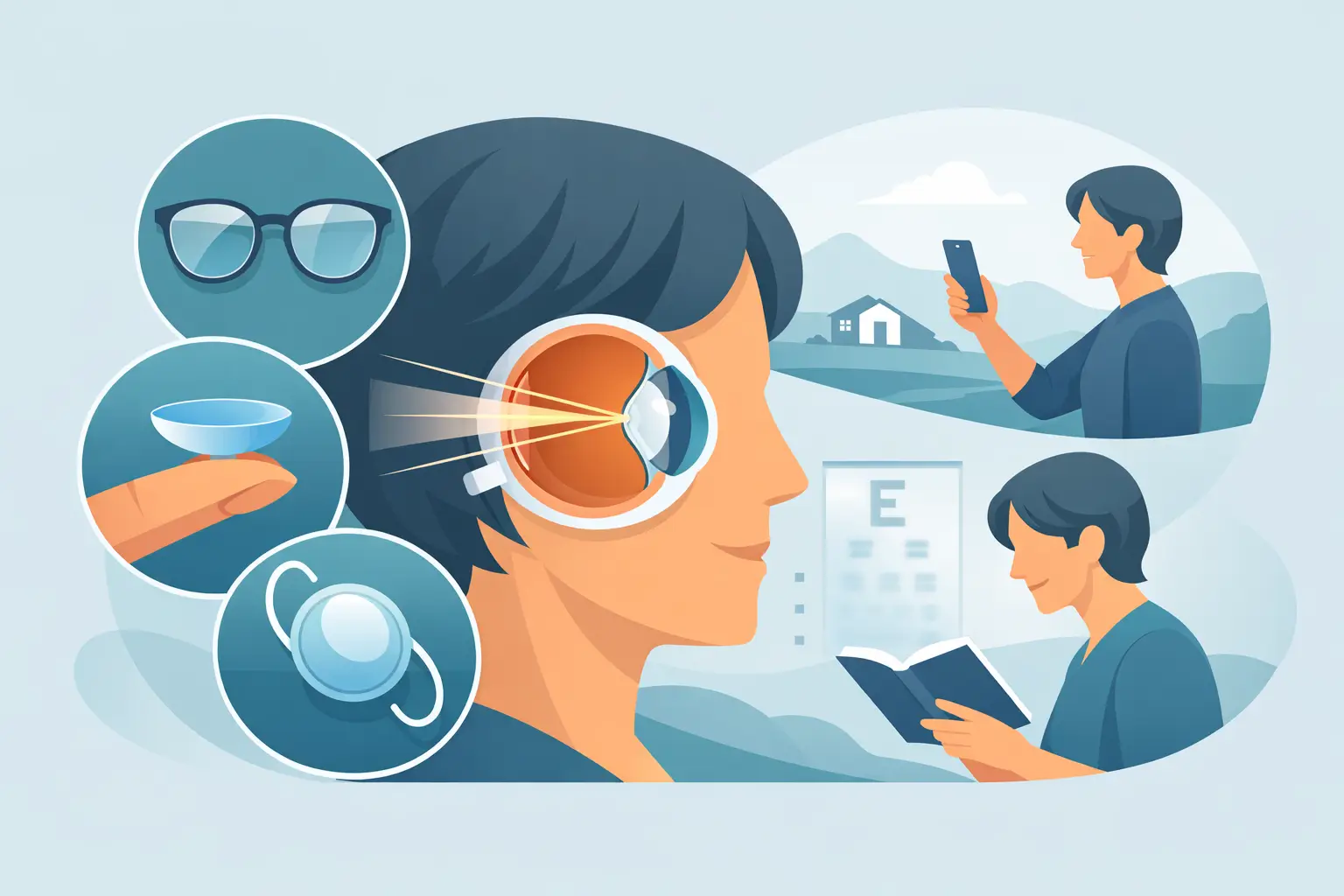
Reading a restaurant menu at arm’s length, reaching for supermarket reading glasses or struggling to see your phone in low light are familiar frustrations of presbyopia. The good news is that presbyopia lens options have developed considerably: for suitable patients, modern intraocular lenses can improve vision at one or more distances and reduce day-to-day dependence on glasses.
The right choice is not simply the lens that offers the widest range of vision. It is the lens that best matches your eyes, your lifestyle and what you are comfortable compromising on. A detailed pre-operative examination is essential, particularly if you are considering lens replacement surgery in your 50s or beyond.
Why presbyopia changes the way you see
Presbyopia is an age-related loss of near focusing ability. Inside the eye, the natural lens gradually becomes less flexible. When you are younger, it changes shape to focus from the distance to a book or screen. Over time, that process becomes harder, which is why reading glasses often become necessary from the mid-40s onwards.
Glasses, contact lenses and laser eye surgery can all help in particular circumstances. However, lens replacement surgery, also called refractive lens exchange or RLE, may be considered when presbyopia is established and a patient wants a more lasting correction. During the procedure, the natural lens is removed and replaced with an artificial intraocular lens, or IOL. The same principle is used in cataract surgery, although cataract surgery is performed because the natural lens has become cloudy.
Presbyopia lens options at a glance
There are three main categories to discuss with your surgeon: monofocal, extended depth of focus (EDOF) and trifocal lenses. Each handles distance, intermediate and near tasks differently.
Monofocal lenses: clear vision at one main distance
A monofocal lens is designed to provide sharp vision at a single focal point, most commonly in the distance. Many people choose it for clear driving, walking, television and outdoor vision, then use reading glasses for close tasks such as books, labels and phone screens. Depending on the target prescription, it can also be set for near vision, but distance glasses would then usually be needed.
Monofocal lenses are a well-established choice and often offer excellent image quality with a lower likelihood of halos and glare than multifocal designs. They can be particularly sensible where the eye has certain corneal, retinal or optic nerve conditions that make a premium multifocal lens less appropriate.
Some patients consider monovision, where one eye is focused more for distance and the other more for near work. This can reduce reliance on glasses, but it is not comfortable for everyone and may slightly affect depth perception. A contact lens trial may sometimes help indicate whether you can adapt to this approach.
EDOF lenses: useful range with fewer compromises for some eyes
EDOF lenses extend the eye’s range of focus rather than splitting light into several distinct focal points. In practical terms, they are often aimed at giving strong distance vision and helpful intermediate vision for tasks such as computer use, cooking, shopping and seeing a car dashboard.
Near vision may be better than with a standard distance monofocal lens, but many patients still need reading glasses for small print, prolonged reading or dimly lit menus. This is an important distinction: EDOF lenses may offer greater freedom from glasses without necessarily delivering the close-reading ability of a trifocal lens.
For suitable patients, EDOF technology can be an appealing middle ground. Some designs may produce fewer or less noticeable night-time visual effects than trifocal lenses, although glare and halos remain possible with any intraocular lens surgery. Your pupil size, night-driving needs and ocular surface health all matter in the decision.
Trifocal lenses: the broadest range of vision
Trifocal lenses are designed to provide vision at distance, intermediate and near ranges. They are often the strongest option for patients who hope to read a phone, use a computer and see into the distance with much less reliance on glasses.
That broader range has a trade-off. By distributing light across more than one focal point, trifocal lenses can cause halos, glare or starbursts around lights, especially in the early weeks or months after surgery. Many people gradually adapt through neuro-adaptation, where the brain learns to process the new visual information more efficiently. For others, these effects can remain noticeable, particularly when driving at night.
Trifocal lenses are not automatically the ‘best’ choice. They work best when the eye is healthy and measurements are reliable. Significant dry eye, irregular astigmatism, macular disease, glaucoma-related damage or other eye conditions may affect suitability and expected results.
Astigmatism correction can be part of the plan
Astigmatism occurs when the front surface of the eye is more rugby-ball-shaped than evenly curved, causing blur or distortion. If it is clinically significant, a toric version of a monofocal, EDOF or trifocal lens may be recommended.
Correcting astigmatism is often crucial to achieving the intended quality of vision. It also explains why two people with apparently similar prescriptions may receive different lens recommendations. The surgeon considers far more than your glasses prescription, including corneal shape, eye length, tear film, retinal health and the precision of the measurements taken before surgery.
How to decide which lens fits your life
A useful starting point is to be honest about the activities that matter most. Someone who drives frequently at night and does not mind using reading glasses may favour the clarity and simplicity of a monofocal lens. Someone who spends much of the day on a laptop and wants less dependence on glasses for everyday tasks may prefer EDOF technology. A keen reader, traveller or active grandparent who values independence at all distances may be more interested in a trifocal lens, provided they understand and accept the possibility of visual phenomena.
Your expectations deserve just as much attention. No lens can recreate the natural focusing ability of a 20-year-old eye in every situation. Even after successful treatment, some patients use glasses occasionally for tiny print, detailed hobbies or demanding low-light tasks. The aim is a personalised improvement in useful vision, not a one-size-fits-all promise of being glasses-free.
What the assessment should cover
A proper consultation should not feel like choosing from a menu. The eye surgeon and clinical team should examine the health of the cornea, lens, retina and optic nerve, assess dry-eye symptoms, measure refraction and astigmatism, and discuss whether a cataract is already affecting your vision.
They should also ask about previous laser eye surgery, medications, diabetes, eye disease and your work and hobbies. These details help predict whether a premium lens is likely to be beneficial and whether any issue should be treated first. For example, managing dry eye before final measurements can improve comfort and measurement accuracy.
Considering lens replacement surgery in Prague
For patients travelling from the UK, Ireland or the USA, Prague can offer access to experienced Czech eye surgeons, modern private clinics and recognised premium intraocular lens technology at a more accessible cost than many private providers at home. The value should never mean cutting corners: ask what lens is proposed, what examinations are included, who performs the surgery and how aftercare will be organised.
A typical visit is planned around pre-operative tests, surgery and a postoperative check before you travel home. Sandonia provides English-speaking support to help patients understand the process, organise their Prague schedule and stay informed before and after treatment. Final suitability and lens selection are always confirmed by the operating eye surgeon following a full examination.
If reading glasses are increasingly dictating your day, request a free suitability assessment or send us your prescription. The most reassuring next step is not to choose a lens online, but to begin a clear conversation about the vision you want and the options your eyes can safely support.
This article is for general information and does not replace a personal medical consultation. All eye surgery carries potential risks, and outcomes vary according to eye health, measurements, lens choice and individual healing.