
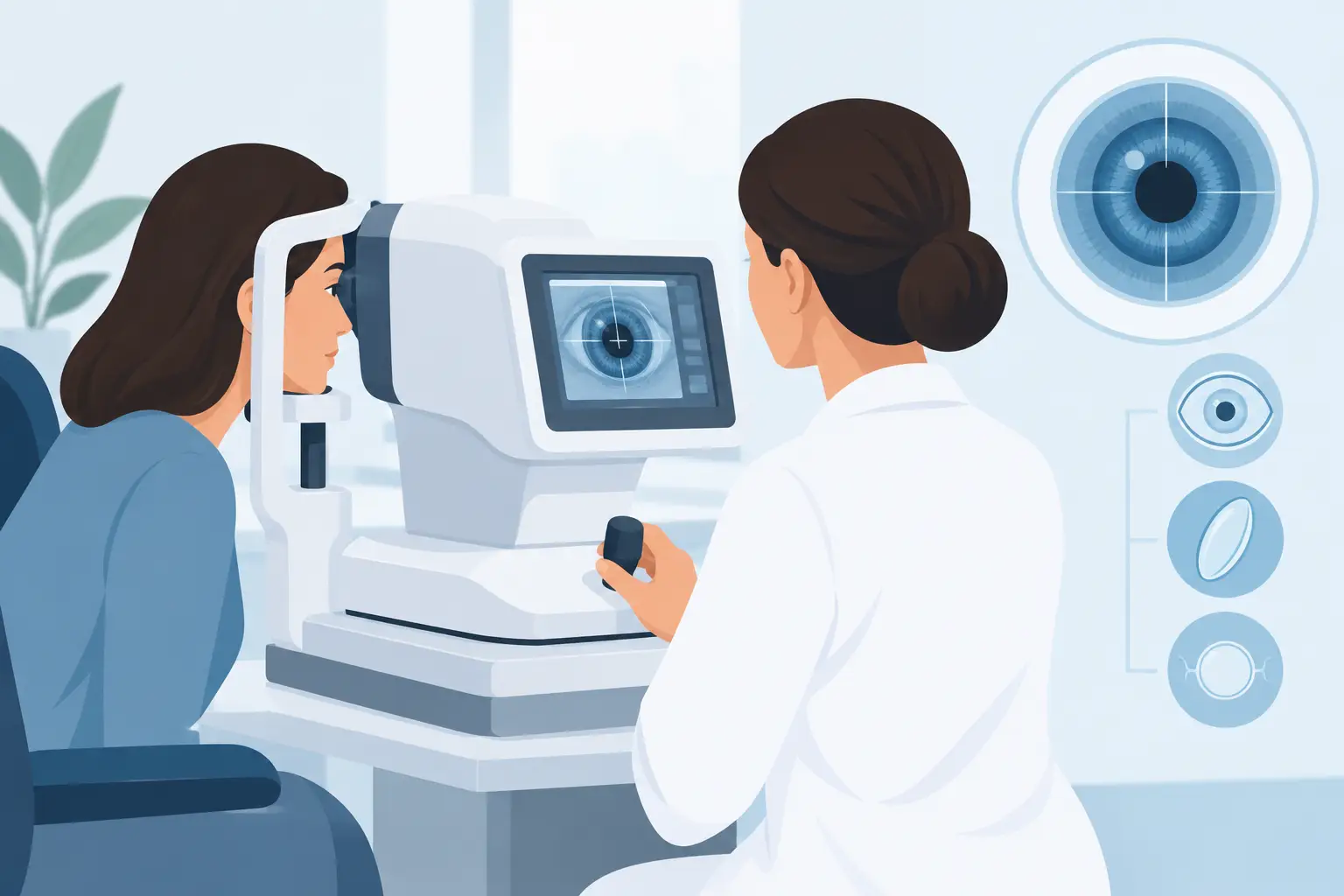
If you are considering lens replacement or cataract surgery, you may be wondering what happens during eye biometry and whether the test is uncomfortable. The short answer is reassuring: it is usually a quick, painless set of detailed eye measurements. Yet it is also one of the most important stages of your preparation, because these measurements help your surgeon choose the intraocular lens and lens power most suitable for your eyes.
For patients hoping to reduce their reliance on reading glasses, distance glasses or both, biometry is not simply a routine scan. It provides the information behind a carefully personalised surgical plan.
What happens during eye biometry?
Eye biometry is a non-invasive examination performed before cataract surgery or refractive lens exchange (RLE). A trained technician or optometrist will normally ask you to sit at a machine, rest your chin and forehead on supports, and look at a small fixation light. The device takes measurements using light, rather than touching the surface of your eye.
You will be asked to keep still and blink normally between readings. The scanning itself takes only seconds per eye, although the full appointment may take longer because several measurements are checked and repeated for accuracy. Most people find it easier than a standard eye test.
Biometry does not involve needles, injections or surgery. Your eyes are not usually dilated for the scan itself, although drops may be needed later in your assessment so that the surgeon can examine the retina and optic nerve thoroughly.
Why these measurements matter for lens surgery
During cataract surgery or RLE, the eye’s natural lens is removed and replaced with an artificial intraocular lens, often called an IOL. Unlike glasses, an IOL sits inside the eye. Its power needs to be calculated precisely.
Even a small variation in the eye’s dimensions can affect the predicted visual result. That is why a current glasses prescription alone is not enough to select an implant. Two people with apparently similar prescriptions may need very different IOL powers because their eyes are shaped differently.
The aim is to select a lens that supports the agreed visual target. For one patient, that may mean clear distance vision with reading glasses. For another, it may mean a greater range of vision through an EDOF or trifocal lens. The best choice depends on eye health, lifestyle, work, night-driving needs and your willingness to accept possible visual compromises such as halos around lights.
Measurements commonly taken
The most important figure is usually axial length – the distance from the front of the eye to the retina at the back. This gives the surgeon a detailed understanding of the eye’s overall length.
The machine also measures the curvature of the cornea, the clear front window of the eye. This is known as keratometry. Corneal curvature affects how light is focused and is particularly relevant when deciding whether a toric lens may help correct astigmatism.
Depending on the equipment and clinic protocol, biometry may also assess anterior chamber depth, lens thickness and the white-to-white diameter of the eye. Modern optical biometers combine these values with sophisticated calculation formulae to predict the most appropriate IOL power.
Your clinical team may also perform corneal topography or tomography. These tests create a detailed map of the cornea and can identify irregularities that a simple measurement may not show. An OCT scan may be used to check the macula, the part of the retina responsible for fine central vision.
What does the appointment feel like?
For most patients, biometry is straightforward. You may notice a bright light or a moving image inside the machine, but there should be no pain. No instrument needs to touch the eye when optical biometry is used.
Occasionally, it is harder to obtain reliable readings. This can happen if you have a dense cataract, difficulty maintaining fixation, a very dry eye surface or certain corneal changes. In these circumstances, the clinician may repeat the scan, treat dry-eye symptoms before remeasuring, or use an ultrasound-based measurement as an alternative.
This is not a sign that something has gone wrong. It is a sensible part of getting dependable information before surgery. A good clinic would rather recheck a measurement than rush the lens calculation.
Dry eyes, contact lenses and other preparation
Your eye surface needs to be as stable as possible for accurate corneal readings. Dry eyes can temporarily alter the tear film and, in some cases, affect keratometry results. If you regularly experience grittiness, fluctuating vision, watering or burning, mention it during your assessment. You may be advised to use lubricating drops and return for repeat measurements once the surface has settled.
Contact lenses can also influence the shape of the cornea. Soft lens wearers are commonly asked to stop wearing lenses for a period before testing, while rigid gas-permeable lenses often require a longer break. Your clinic will give you individual instructions based on the type of lenses you wear and how long you have used them.
Bring your current glasses and, if available, details of previous eye procedures. Past laser eye surgery is especially relevant. LASIK, PRK and similar treatments change the cornea’s shape, so the lens calculation requires extra care and may involve specialised formulae. You can still be suitable for cataract surgery or RLE after laser eye surgery, but expectations and lens options should be discussed carefully.
How biometry helps choose between lens options
Biometry is essential whichever lens type you choose, but it becomes particularly valuable when considering premium lens options. A monofocal lens is designed around one main focal distance, commonly distance. It can offer excellent clarity, but reading glasses are often still needed for close work.
An EDOF lens can provide a broader range, often supporting distance and intermediate tasks such as shopping, cooking or using a computer. Fine print may still require glasses. Trifocal lenses are designed to provide distance, intermediate and near vision, but they are not ideal for every eye or lifestyle. Some patients notice halos, glare or reduced contrast in low light, particularly while neuro-adaptation takes place.
Biometry helps with the lens-power calculation, but it is only one part of the decision. The surgeon will also consider retinal health, corneal regularity, glaucoma risk, pupil characteristics and your everyday priorities. A lens that sounds attractive on paper may not be the most appropriate choice for your eyes.
Can biometry guarantee perfect vision?
No. Eye biometry has made lens calculations highly accurate, especially with modern optical equipment, but medicine cannot promise an exact outcome for every individual. Natural healing, subtle changes in the eye, pre-existing eye conditions and the limits of measurement technology can all influence the final result.
Sometimes a small residual prescription remains after surgery. This may be managed with glasses for selected tasks, and in suitable cases a further procedure may be discussed. The goal is not to make unrealistic promises. It is to use the best available measurements, lens technology and surgical expertise to give you a well-informed, personalised plan.
Biometry when travelling to Prague for surgery
For patients travelling from the UK, Ireland or the USA, a thorough pre-operative assessment is particularly valuable. It confirms that surgery is appropriate, gives the surgeon the measurements needed for planning, and allows time to discuss lens options in clear English before treatment.
At a modern Prague clinic, biometry is normally completed alongside other important checks during your examination schedule. Sandonia supports patients through this process, helping them understand what each test means and what practical arrangements to make before surgery. Your final recommendation should always come after the surgeon has reviewed the complete examination, not from a prescription or online questionnaire alone.
If you are thinking about cataract surgery or lens replacement abroad, send us your prescription or request a free suitability assessment. Knowing your starting point is helpful, but the detailed measurements taken at your consultation are what turn an interest in better vision into a properly considered treatment plan.
This article is for general information and does not replace a full eye examination or advice from an ophthalmic surgeon. Your suitability, lens choice and expected visual outcome can only be confirmed after detailed pre-operative testing.