
A wet road, oncoming headlights and unfamiliar signs can make even a routine evening journey feel demanding. If you are asking which lens suits night driving, the most useful answer is not simply a lens name. It is about matching the optical qualities of a lens to your eyesight, eye health, driving habits and tolerance for visual effects such as glare and halos.
For people considering cataract surgery or lens replacement surgery, night vision is a sensible priority to raise early. A premium intraocular lens can reduce your reliance on glasses, but every lens design involves a balance between distance, intermediate and close vision. The right choice should follow detailed measurements and a consultation with an experienced eye surgeon.
Why night driving can become difficult
Night driving places greater demands on the eyes than daytime driving. In low light, the pupil widens and the eye has less contrast to work with. Headlights, street lamps and reflective road markings can create glare, while rain and a dirty windscreen scatter more light still.
Changes inside the eye can add to the problem. A developing cataract may cause hazy vision, reduced contrast and more pronounced glare around lights. Dry-eye symptoms can also make vision fluctuate, particularly with long periods of concentration behind the wheel. Even an outdated glasses prescription can leave road signs and hazards less clear than they should be.
Before choosing a surgical lens, it is worth checking that the difficulty is not mainly caused by dry eye, an uncorrected prescription, cataract changes or another eye condition. These issues may need treatment or consideration in their own right.
Which lens suits night driving after lens surgery?
For patients who drive frequently after dark, especially on motorways or rural roads, a monofocal lens is often the most predictable option for clear distance vision with fewer unwanted light effects. It has one main focus, usually set for distance. This can make it a strong choice for driving, television and seeing faces across a room.
The trade-off is that most people will still need reading glasses for a phone, menu, book or close detail. Some may also prefer glasses for computer work, depending on the chosen focus and their individual visual needs. A monofocal lens does not remove the need for glasses in every situation, but it can offer excellent quality distance vision when the eye is otherwise healthy.
An EDOF lens, meaning extended depth of focus, is another option worth discussing. It is designed to stretch the range of clear vision beyond distance, often providing useful intermediate vision for dashboard displays, a sat-nav, shopping shelves and computer screens. Many EDOF lenses are designed to minimise dysphotopsias – visual effects such as halos and starbursts – compared with multifocal designs, although no lens can guarantee that these effects will not occur.
For some patients, EDOF lenses provide an appealing middle ground: more day-to-day independence from glasses than a standard monofocal lens, with a night-vision profile that may be more comfortable than a trifocal lens. Fine print will often still require reading glasses.
A trifocal lens is designed to provide vision at distance, intermediate and near ranges. It can be an excellent option for someone who values reading without glasses, using a phone and managing close tasks alongside distance vision. However, because light is distributed across several focal points, some patients notice halos, glare or rings around lights, particularly during the early period after surgery.
Many people adapt well over time through neuro-adaptation, where the brain learns to process the new visual information more efficiently. Yet if night driving is central to your work, lifestyle or confidence, it is vital to discuss this trade-off openly. A trifocal lens may still be suitable, but it should not be selected solely because it offers the widest range of vision.
A simple guide to the trade-offs
In broad terms, monofocal lenses tend to prioritise crisp distance vision and may be preferable for regular night drivers who accept reading glasses. EDOF lenses can offer a useful greater range of vision while seeking to limit night-time optical effects. Trifocal lenses offer the strongest potential for reducing dependence on glasses across all distances, but can involve a greater chance of noticing halos or glare.
That is a helpful starting point, not a prescription. Lens models vary, and the quality of your cornea, retina, tear film, pupil size and pre-existing astigmatism all influence the result.
Astigmatism correction matters too
Astigmatism means the front surface of the eye is shaped more like a rugby ball than a football. It can blur or distort vision at any distance, and at night it may make headlights appear smeared, streaked or star-shaped.
Where measurements show clinically meaningful astigmatism, a toric version of a monofocal, EDOF or trifocal lens may be recommended. Correcting it can sharpen uncorrected vision and may reduce dependence on glasses after surgery. A toric lens is not automatically necessary for everyone, but it is an important part of a careful night-driving discussion.
Are yellow-tinted night-driving glasses the answer?
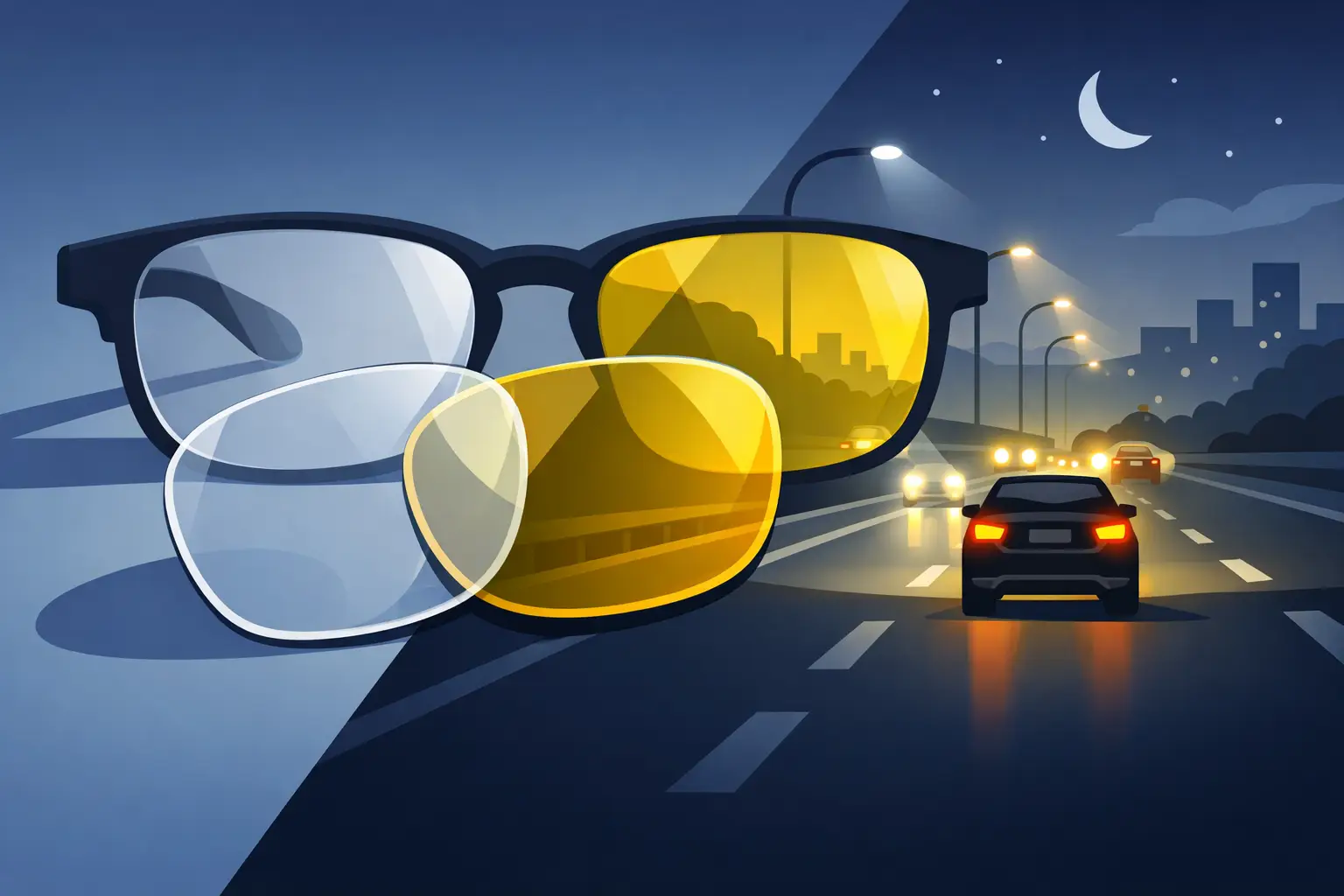
Yellow or amber night-driving lenses are widely marketed, but they are not a dependable solution for poor night vision. Although some people find that a tint feels more comfortable in particular conditions, it reduces the amount of light reaching the eye. In genuinely dark conditions, that may be unhelpful.
If you wear glasses for driving, a clear and accurate prescription with a high-quality anti-reflective coating is generally the more practical approach. Keep both sides of the lenses clean, as fine smears and scratches can noticeably increase light scatter. Equally, clean the inside and outside of the windscreen, and replace worn windscreen wipers. These small details genuinely matter on a rainy night.
Questions to ask at your consultation
A good lens consultation should go beyond the question, “Do you want to be glasses-free?” Tell the surgeon how often you drive at night, whether you drive professionally, how confident you currently feel with headlights, and which tasks matter most to you.
It can help to explain whether you would happily use reading glasses in exchange for prioritising night-time distance vision, or whether freedom from glasses for close work is your strongest goal. There is no universally best answer. There is only the lens strategy that makes the most sense for your eyes and your routine.
Your assessment should include a refraction test, corneal measurements, checks for dry eye and an examination of the retina and optic nerve. If cataracts are present, their density and effect on vision will also be considered. The surgeon can then explain which lens types are realistic options and whether a premium lens is likely to offer worthwhile benefits in your case.
Planning lens surgery in Prague
Patients travelling for cataract surgery or refractive lens exchange understandably want clarity before committing to treatment abroad. A reputable programme should provide an English-speaking discussion of lens options, transparent information about what is included, pre-operative testing, surgery, postoperative checks and a sensible plan for follow-up once you return home.
Prague offers access to experienced Czech eye surgeons, modern private clinics and recognised premium intraocular lens technology, often at a more accessible cost than private treatment in the UK, Ireland or the USA. Sandonia supports English-speaking patients through the practical and clinical stages of this journey, including suitability information, travel planning and postoperative guidance.
You should not plan to drive immediately after surgery. Vision commonly improves quickly, but recovery varies and early healing requires care. Your surgeon will advise when your vision meets the appropriate standard for driving and when it is safe to return to the road. If you are travelling, arranging support and avoiding a rushed return journey can make the experience more comfortable.
Make night driving part of the decision, not an afterthought
The best lens for night driving is often the one that respects your priorities rather than promising every visual benefit at once. If you want the greatest confidence at distance after dark, a monofocal or carefully selected EDOF lens may be worth particular consideration. If reducing reading-glasses dependence is equally important, a trifocal lens may still be appropriate once you understand and accept the possible visual compromises.
A full pre-operative examination is the only reliable way to confirm suitability and discuss expected results. If night driving has become stressful, request a free suitability assessment and make it one of the first things you mention. Clearer, more comfortable journeys often begin with a lens choice tailored to the life you actually lead.
This information is for general guidance and does not replace a full consultation with an eye surgeon. All surgery carries potential risks, and visual outcomes depend on individual eye health, measurements and the lens recommended after assessment.